
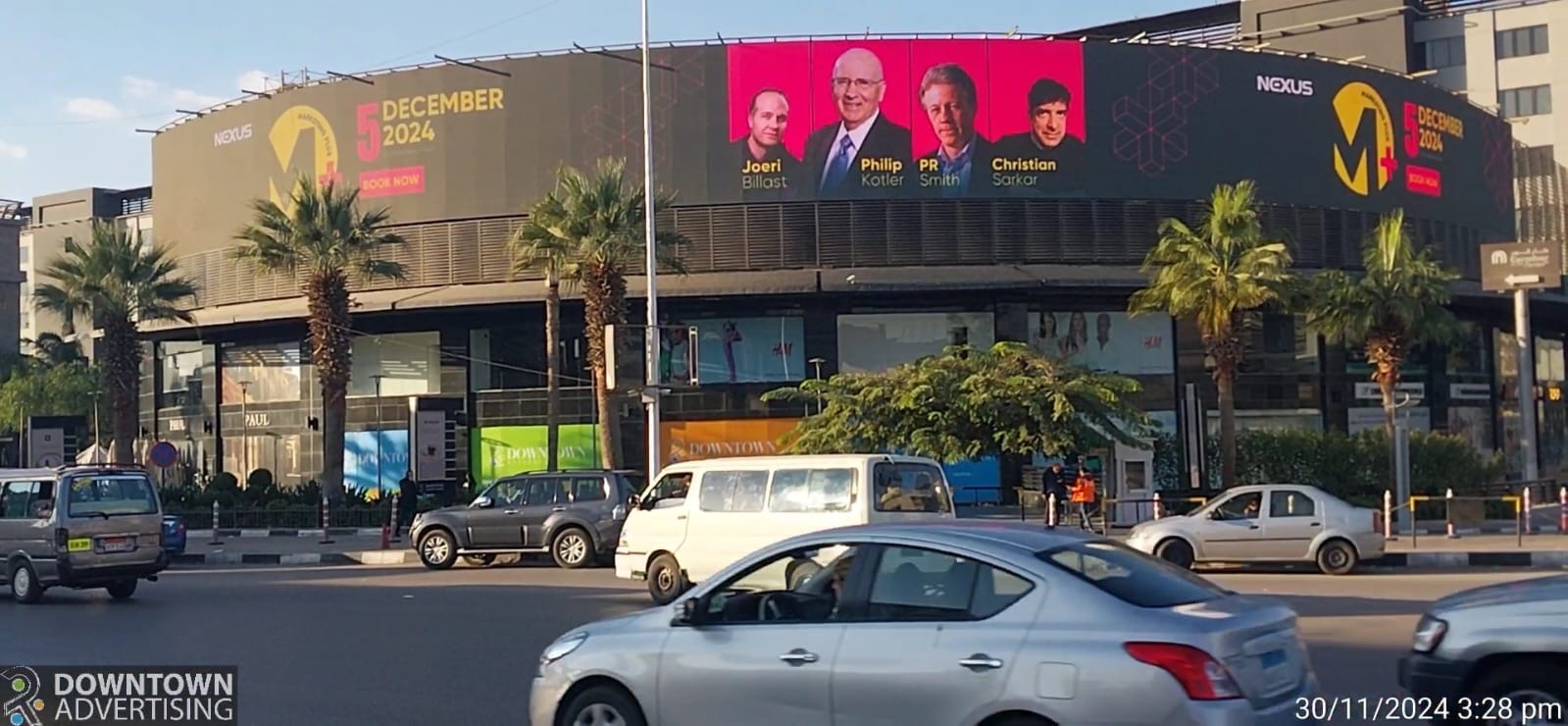
The billboard in Cairo
In December 2024 my face was on a billboard in fifteen locations across Cairo, a city of 22 million people. Next to it was the face of Philip Kotler, the man who turned marketing into an academic discipline and whose textbook has been the standard in business schools since 1967. We were both speaking at the same conference. He joined by video. I was there in person.
I am not telling you this for the vanity of it. I am telling you because of what happened after. I asked Kotler to come on my podcast, Web3 CMO Stories, and he said yes. Drawing on Gautam Mahajan's book on zero complaints, he told my listeners that CMOs should want every complaint to come up to them on a list every week, and that a company might even appoint a chief problem officer. In other words, the CMO should own every customer problem, wherever in the company it starts. When the person who defined the discipline argues that, you stop optimising and you start asking what you missed. My conclusion was that the marketing leadership role is not evolving. It is undergoing a reconstruction.
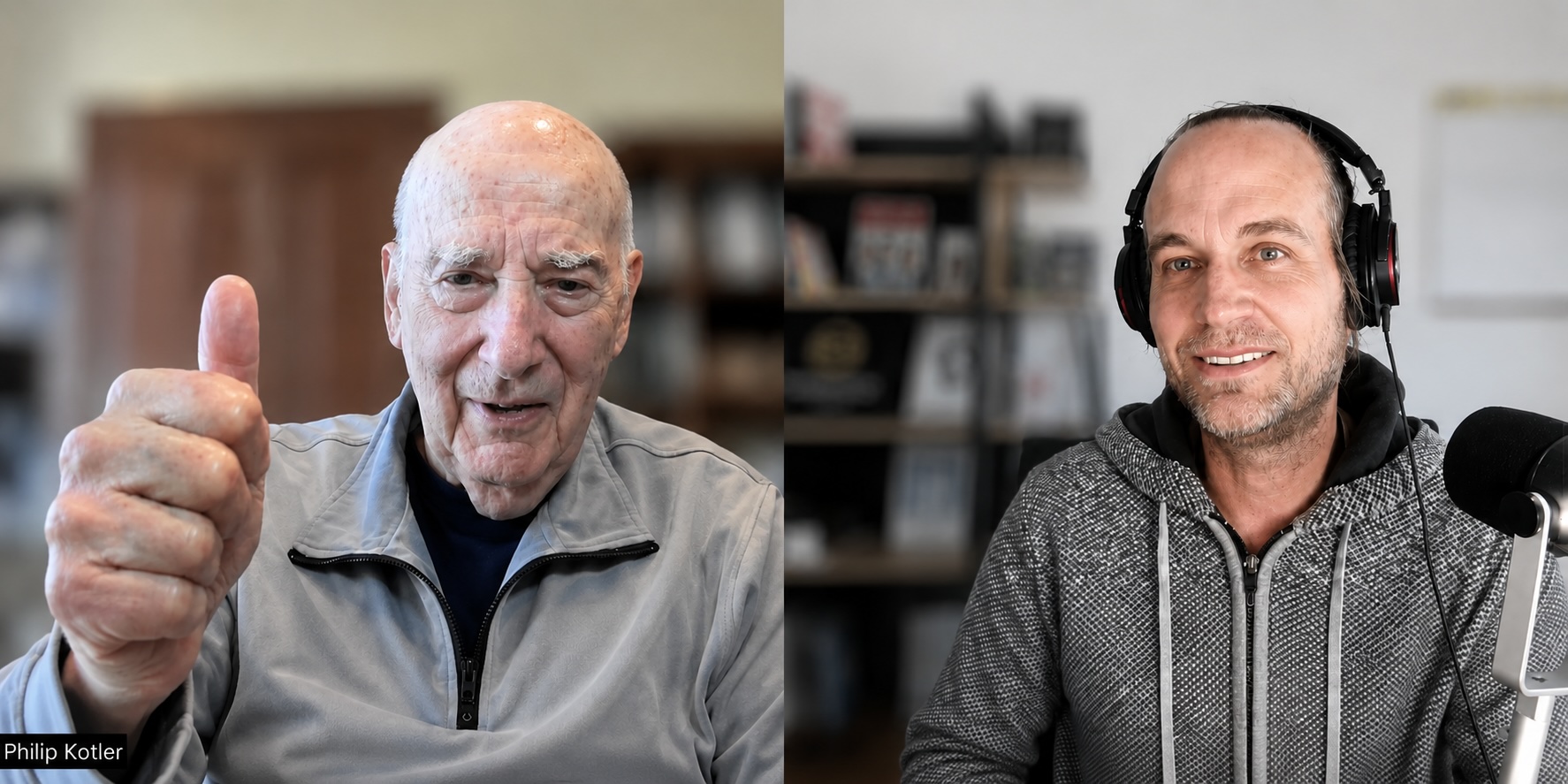
I wrote the answer down over eight chapters. The book became The Future CMO. When it was finished I sent it to him. His endorsement opened with one sentence. He called it the best update he had read on the role and work of CMOs. I could not say that sentence out loud for two weeks, because if Kotler thinks the role needs an update, then collectively we have missed something fundamental.
This page is about what we missed, and what the future CMO does instead.
The collapse nobody is pricing in
Here is the uncomfortable part. AI did not just democratise marketing competence. It commoditised it.
Ten years ago there was a real gap between a good marketer and an average one. The good one wrote sharper copy, built better campaigns, found cleaner positioning. That craft was a moat. Today a junior with ChatGPT produces technically correct copy in five minutes, and so does a senior with the same tools. The gap between good and average has collapsed in about twelve months.
Most marketing leadership is still treating this as a tooling problem. Which prompts, which stack, how much to automate. Those are the wrong questions, because everyone is already working on them, and when everyone works on the same questions, differentiation disappears. The problem was never that AI makes humans useless. The problem is that AI makes sameness easy, and sameness is the enemy of trust.
This is not only my read. Lippincott's CMO Outlook 2026, a global study of more than 500 marketing leaders developed with Bloomberg Media, found investment flowing toward AI technologies while funding moves away from websites and content creation, the very foundations that shape how AI understands and surfaces a brand. Marketers are automating output while starving the things that make a brand worth recommending. That is the gap this book closes.
Why the moat moved from output to meaning
The old agency moat was output. More posts, more campaigns, more channels, more speed. That worked when production was hard. Production is no longer the bottleneck. The bottleneck now is meaning.
Can your client say something that actually matters. Can their market recognise their point of view. Can a stranger verify their credibility before the first sales conversation. Those are not creative questions, they are business questions, and clients will not pay premium fees for output that a model can generate. They will pay for clarity, for judgment and for trust.
So the new moat looks different from what most teams are still selling. It is a defensible point of view, trust signals a customer can verify, a community that compounds and strategic judgment rather than volume.
The three shifts of the future CMO
I have structured this reconstruction into three shifts. Most teams are still stuck on the left side of each one.
Shift one: from attention to trust
For more than a decade marketing has been obsessed with attention. Reach, impressions, views, clicks. Attention still matters, but it is no longer the hard part. The hard part is what happens after. Do people believe you, stay, refer you, pay a premium and defend you when something goes wrong. That is where the business value sits.
You can get attention and still have no trust. You can go viral and still not matter. And trust is now measurable. Trusted brands can command a price premium of up to 30 percent over untrusted competitors, according to BrandSpark's multi-country consumer trust research. Edelman's 2025 Trust Barometer special report on brand trust, covering 15 markets, ranks trust in the company behind a brand alongside cost and quality as a purchase consideration. Customers who arrive through a referral, which is trust made visible, are worth more too: in a study of bank customers published in the Journal of Marketing, Philipp Schmitt, Bernd Skiera and Wharton's Christophe Van den Bulte found referred customers were 16 to 25 percent more valuable than comparable customers, depending on how value is measured. These are business metrics, and most marketing dashboards do not track a single one of them.
That is why I built the Trust ROI Calculator into the book. It turns trust from a vague virtue into a line your CFO can read. You map where trust signals appear across your touchpoints, measure trust through satisfaction, retention and referral velocity, calculate your pricing power against competitors, track how fast you recover from a reputation incident and link all of it to revenue on the same dashboard the finance team already uses.
Shift two: from content volume to point of view
AI made it trivial to publish more. More posts, blogs, videos, newsletters. But publishing more is not a strategy, it is often just noise, and the market is already full of it. Mark Schaefer, who I interviewed on the podcast and who joined my Sintra Synergies retreat, puts it plainly: competence is ignorable, audacity cuts through.
A defensible point of view has three properties. It is specific, naming what is broken in your industry by name rather than in vague terms. It is defensible, backed by your own experience, data or a pattern you have actually seen. And it is repeatable, showing up consistently across everything you publish.
Here is the test. If you swapped your competitors' logos onto your content, would it still feel like yours. For most marketers the honest answer is no, and that is the whole problem. If your brand has no point of view, AI will only help you say nothing faster.
When you do have a real point of view, something else happens. You stop attracting an audience and you start attracting a community. An audience listens, a community participates. An audience consumes, a community contributes. An audience gives you attention, a community gives you trust. That is why the book includes a Community Health Calculator built on four dimensions: participation rate, content quality index, member retention at 90 and 365 days and the ratio of community driven to brand driven content.
Shift three: from tool adoption to strategic leadership
This is the most important shift, and the most misunderstood. There is a belief that using more AI tools automatically makes you more advanced. It does not. AI tools do not make you a better CMO. They expose whether you were one.
If your strategy is weak, AI scales weak strategy. If your positioning is generic, AI produces generic content faster. If your brand has no trust, AI will not manufacture it for you. AI does not fix a lack of leadership. It amplifies it.
That is why the role itself is changing. The brand guardian becomes a Chief Value Officer. The campaign manager becomes a community architect. The creative director becomes a trust architect. The tool operator becomes a strategic translator. These are not title changes. They are a re-conceptualization of what the role does. This is what I mean by reconstruction.
What a Chief Value Officer actually is
A Chief Value Officer is a marketing leader who is accountable for the value a brand earns and can prove, not the attention it rents. Where the traditional CMO optimised for reach and output, the Chief Value Officer optimises for trust, defensible positioning and community, and ties those to financial outcomes the rest of the C-suite already respects. It is the role marketing leadership grows into when content becomes infinite and trust becomes the filter.
There is a deeper logic here that explains why this is a reconstruction and not a promotion. A CEO exists to create value for the organisation as a whole. The Chief Value Officer applies that same logic to the part of the business where value is most visibly created and captured, which is the surface where a brand meets its market. That is why this is not an upgraded marketing title. It is a role whose core question, how do we create and prove value while using resources well, is the same question the CEO is accountable for. When you frame the role that way, it stops reporting to value and starts owning it.
The four minute test: the AI Visibility Check
Here is something you can run on yourself, a brand or a client this week. Four questions.
First, is your brand citable by AI. When ChatGPT, Claude or Perplexity answer questions in your category, does your name appear. If you are not citable there, you do not exist for the buyers who start their research with AI. The operational side of this is its own discipline, and I have written the full playbook separately on how to make your brand citable by AI.
Second, do you have a defensible point of view. Same logo test as before. If a competitor could swap their logo onto your content and it would still feel theirs, what you have is not a point of view, it is competent noise.
Third, can a stranger verify your trust signals in 30 seconds. Not three clicks deep on an About page. At the surface. Named clients, real testimonials, endorsements from people who matter.
Fourth, are you optimising for trust or for attention. What gets celebrated internally, the viral post or the quiet client outcome that took six months. What you celebrate, you get more of.
Honest answers to those four questions give you a radically different priority list than the one most marketing teams are working from right now.
Where this came from, and where it is going
This thesis did not arrive fully formed. It was built across 300 conversations on Web3 CMO Stories with people like Gary Vaynerchuk, Chris Do and Joe Pulizzi, pressure tested on stage at TEDxChiado in March 2026 in a talk called Why Trust Is the Only Thing AI Cannot Scale and argued live at NEXT.io in Valletta in a fireside chat titled Is the CMO Dead. Long Live the Chief Value Officer. The book gathered it into one place. The retreat, Sintra Synergies, is where senior marketers and agency owners work it through together.
The line I keep returning to is the one I closed the TEDx talk on. When content becomes infinite, trust becomes the filter. AI can scale almost everything. It can generate content, images, campaigns, even strategy documents. The one thing it cannot scale is the thing that makes a brand fundamentally valuable. Trust can only be earned, one interaction at a time, one promise kept at a time, one client at a time. That is the reconstruction I mean. And that is the work of the future CMO.